Fit at Home: 4-Week Minimal-Equipment PDF Workout Plan
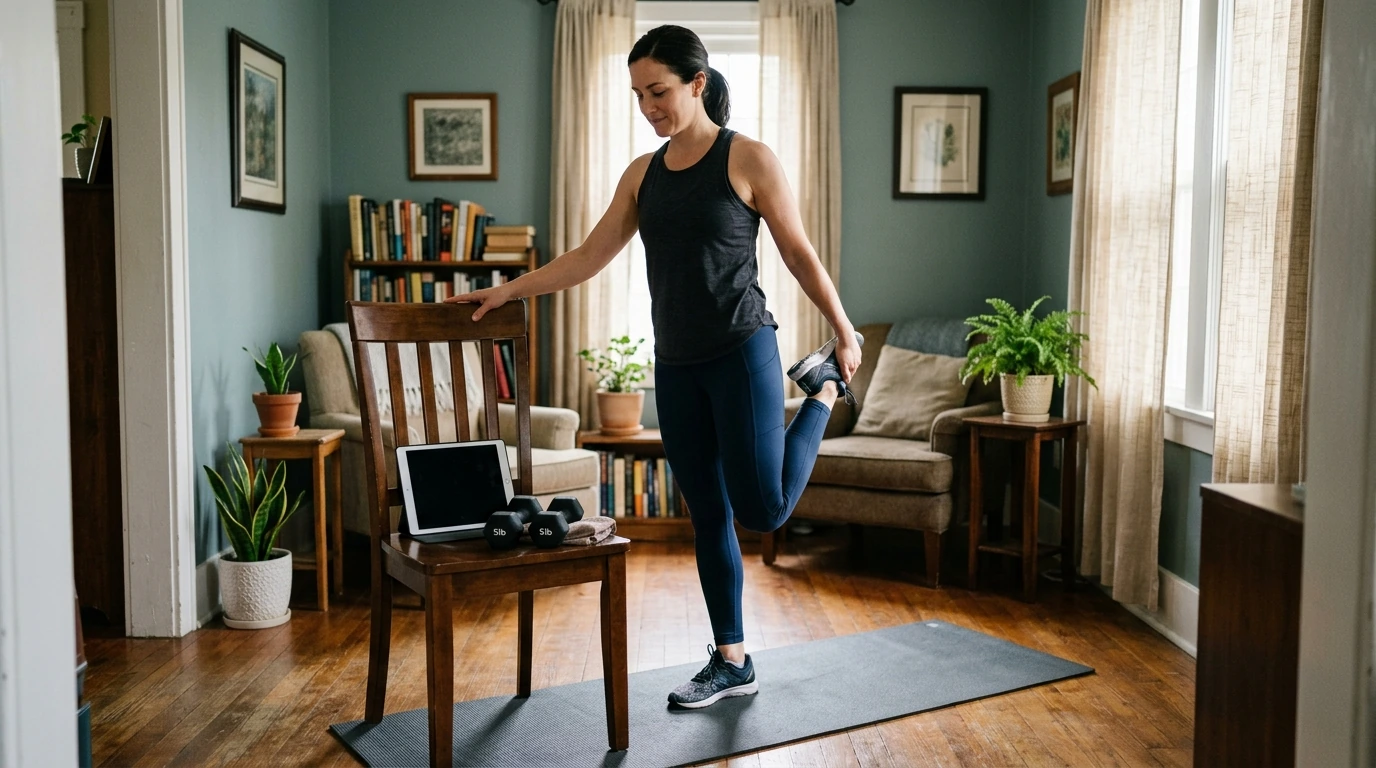
Fit at Home: a 4-week plan that removes the daily “what should I do?”
When life is busy, the hardest part of getting consistent is deciding what to do each day. Our team created Fit at Home as a 4-week, minimal-equipment workout plan in PDF form designed to remove that daily guesswork with structured workouts and built-in stretching—so a living room, a small space, and a few basics are enough to keep momentum going.
If you’ve ever opened a fitness app, scrolled for 15 minutes, and then lost your window to work out, this format is for you: open the guide, do the day, and get on with the rest of your life.
What “Fit at Home” means in real life
Fit at Home is built around a simple principle: consistency comes easier when the plan is already decided. Here’s what that looks like once you’re actually using it:
- A repeatable routine that fits around real schedules—open the guide, follow the day, and move on.
- Full-body movement patterns (lower body, upper body, core, and conditioning) instead of complicated gym setups.
- A minimal-equipment approach to reduce barriers when space and gear are limited.
- Daily stretches included to support recovery, mobility, and that “I can move better tomorrow” feeling.
If you’d like a general benchmark for weekly activity, the CDC provides straightforward guidance on recommended amounts of aerobic and muscle-strengthening activity: CDC — How much physical activity do adults need?.
What’s inside the PDF workout guide
We organized the PDF so you can follow it on a phone, tablet, or printed pages without hunting for details. It’s meant to be easy to start and easy to keep going.
- A 4-week layout with daily workouts to make consistency easier than piecing together random videos.
- A clear daily structure that helps balance effort and recovery across the week.
- Stretches paired with training days so cooldowns don’t get skipped.
- An at-a-glance format that works well on a phone, tablet, or printed pages.
At-a-glance: how the plan is organized
| Part of the guide | What it helps with | How to use it |
|---|---|---|
| Daily workout pages | Removes decision fatigue | Follow the day’s sequence and check it off |
| Stretching/cooldown guidance | Mobility and recovery | Use after workouts or on lighter days |
| 4-week progression flow | Steady improvement without overthinking | Repeat weekly rhythm while building consistency |
| Minimal-equipment approach | Keeps the plan doable anywhere | Swap in what’s available without losing the structure |
Minimal equipment, maximum follow-through
Home workouts only work if they’re easy to start. Our team designed the plan for home realities: limited space, limited time, and no desire to set up a full gym.
- Works well with basics many households already have (like a mat, a sturdy chair, or light weights if available).
- Keeps setup time low and transitions simple so you don’t burn your motivation before you begin.
- Stays useful during travel weeks, bad weather, or seasons where getting out the door is the biggest hurdle.
For broader resistance-training best practices (like frequency and general recommendations), you can also reference: American College of Sports Medicine (ACSM) — Resistance training recommendations.
How to pace a week so it feels sustainable
The fastest way to quit a plan is to treat every day like a test. Instead, aim for a repeatable rhythm that respects your schedule and recovery.
- Protect a realistic time window. Morning, lunch break, or after bedtime routines—pick the slot you can repeat.
- Use effort “levels,” not perfection. Some days are about strength, some about movement quality, and some about recovery.
- Keep recovery visible. Stretching and lighter sessions are what make hard weeks survivable.
- If you miss a day, don’t double up. Resume with the next day to keep the rhythm intact.
A simple daily routine to make the plan stick
- Start: Set a timer, clear a small floor space, and commit to the first 5 minutes. Starting is the win.
- During: Prioritize form and breathing. Controlled reps beat rushed reps when equipment is minimal.
- Finish: Do the day’s stretches to downshift from training mode and reduce stiffness later.
- Track: Mark the day complete (printed checkbox or a notes app) to build a visible streak.
Progress over 4 weeks without getting overwhelmed
In a home plan, progression doesn’t have to mean bigger and bigger gear. Often, the best improvements come from repeating the fundamentals consistently.
Stretching and mobility: the piece most people skip (and miss)
If you want simple examples of flexibility work to keep on hand, this overview is a helpful reference: NHS — Stretching exercises.
Who this 4-week home plan fits best
How to get started the same day you buy it
Recommended downloads from our store
- Fit at Home: 4-Week Workout Plan | Minimal Equipment Exercise Guide PDF | Home Fitness eBook with Daily Workouts & Stretches — a day-by-day plan with workouts plus stretching built in.
- Cardio + Strength Done Right — a checklist-style companion when you want to combine cardio and strength without turning your week into a puzzle.
FAQ
What is fit at home?
Fit at home is a structured, home-based fitness routine designed for limited space and minimal equipment, emphasizing consistency through daily workouts and stretches across four weeks.
Do you need equipment to follow the 4-week plan?
No—this plan is minimal-equipment focused and can work with common household basics like a mat or sturdy chair. If you do have light weights or bands, you can incorporate them, but the structure stays effective either way.
How long should each daily session take?
Session length depends on your pace and rest, but the plan is designed to be manageable for typical home schedules. Choose a realistic time block you can protect, and aim to complete the day’s workout plus the included stretches.








Leave a comment