Cat Body Language Cheat Sheet: Read Tails, Ears & Meows
Cat Body Language & Behavior Cheat Sheet: a calmer way to understand what your cat is saying
Cats communicate all day long—just not in the way most people expect. A slow blink can be affection, a twitching tail can be irritation, and a “meow” can mean anything from “hello” to “please fix this now.” Our printable Cat Body Language & Behavior Cheat Sheet is designed to make everyday cat communication easier to read at a glance, so routines feel calmer, handling feels safer, and bonding feels more natural.
Why a “cheat sheet” helps more than memorizing random cat facts
Cat communication is multi-layered. Most of the time, your cat isn’t sending one clear “signal”—they’re sending a bundle of signals that add up to a message.
- Look for clusters, not single clues: posture + ears + eyes + tail usually tell the real story.
- Many “sudden” swats aren’t sudden: they’re the last step after smaller warnings were missed.
- Real life moves fast: a quick-reference printable helps during introductions, grooming, carrier practice, play, and guest visits.
- Consistency reduces stress: in a multi-person household, our team loves tools that help everyone respond the same way to the same signals.
Core cat communication channels: what to watch first
When you’re unsure how your cat feels, start with the “fastest changing” cues before you decide what to do next.
- Eyes: slow blinks, staring, wide pupils, and half-lidded relaxation can quickly show comfort vs. rising arousal.
- Ears: forward curiosity, sideways uncertainty, and flattened fear/defense—ears often shift before the rest of the body commits.
- Tail: upright greeting, loose swish, sharp thump, puffed fear; speed and stiffness matter as much as direction.
- Body posture: loose/curved vs. stiff/leaning; a tense freeze can be a bigger warning than a hiss.
- Voice: meows are usually “for people,” purrs can be comfort or self-soothing, and growls/yowls are commonly distance-increasing signals.
If you’d like deeper behavior context from veterinary-led organizations, we recommend resources from International Cat Care (iCatCare), the ASPCA, and AAHA.
Quick-read table: signals, meaning, and the best next move
Use this as a decision shortcut: observe → interpret → respond. When signals conflict (like purring with a stiff body), prioritize body posture and ears over the sound. The safest default response is lowering pressure: pause, reduce noise, create space, and let your cat choose to re-engage.
| What you notice | What it often means | What to do next |
|---|---|---|
| Slow blink + relaxed face | Comfort and trust | Slow blink back; keep interactions gentle and predictable |
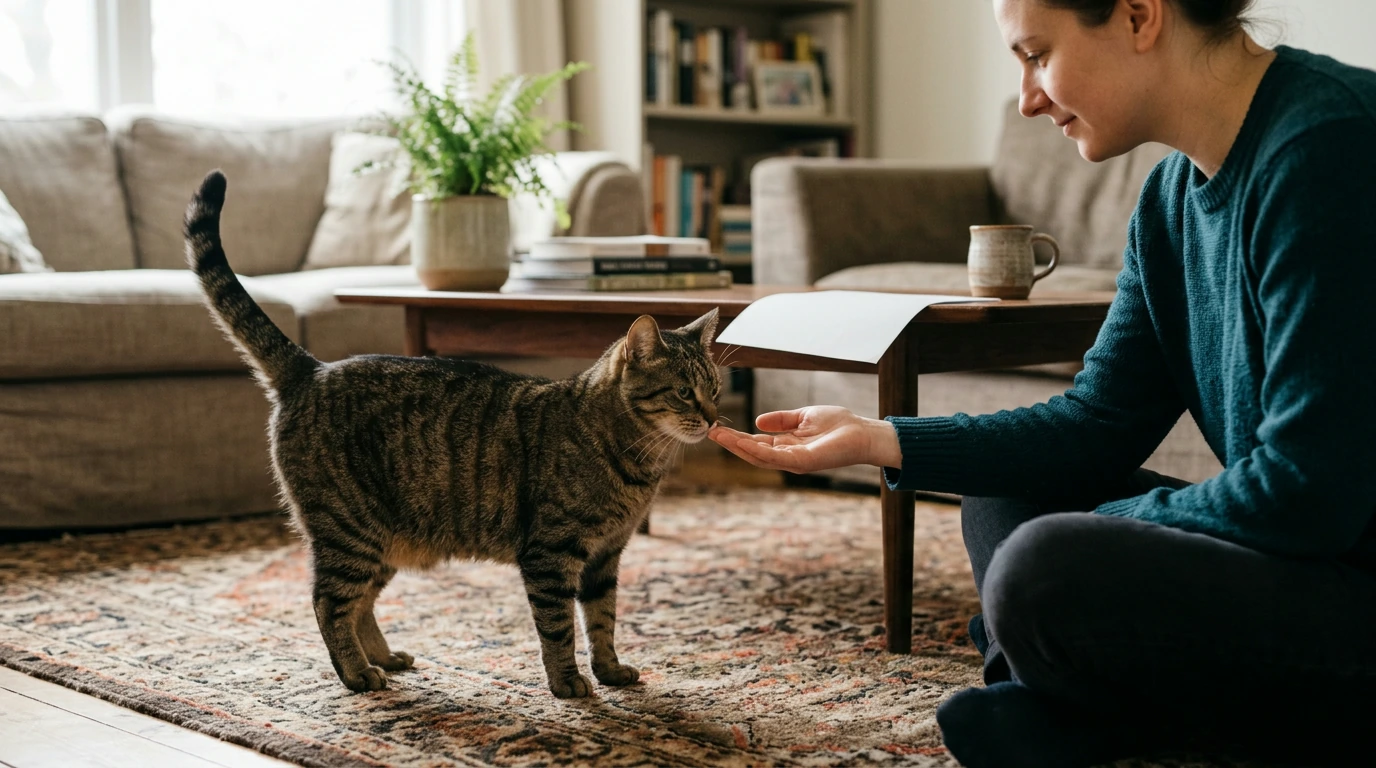
| Ears forward + tail upright | Friendly interest / greeting | Offer a hand to sniff; invite interaction rather than reaching |
| Tail flicking sharply + tense shoulders | Overstimulation or irritation building | Pause petting; give space; switch to calm play or end the session |
| Flattened ears + crouch + wide pupils | Fear/defense | Back off; reduce noise; provide a hiding option; avoid picking up |
| Arched back + puffed tail | High fear or startle response | Increase distance; block access to triggers; let your cat reset |
| Head rub / bunting | Scent-marking + affiliation | Allow rubbing; keep hands low; reward with calm attention |
| Kneading (often with purring) | Comfort/self-soothing | Let it continue; provide a soft blanket; avoid interrupting |
| Chattering at birds/windows | Excitement/frustration at prey | Offer enrichment: wand play, puzzle feeder, window perch |
| Meow at you near bowls/doors | Request directed at people | Check basics: food, water, litter, access; respond consistently |
| Hiss or growl | Clear “back off” boundary | Stop advancing; increase space; end handling; reassess triggers |
Meows, purrs, chirps, and yowls: common meanings without guessing games
- Meows: often “human-directed.” If meowing reliably leads to results, your cat may use it more often and more specifically.
- Purring: can mean contentment, but also self-soothing during stress, pain, or recovery—pair it with posture and appetite.
- Chirps/trills: frequently a friendly greeting or a “follow me” cue (especially when your cat is leading you somewhere).
- Yowling: can indicate distress, territorial tension, mating-related behavior (if not spayed/neutered), or discomfort; context is everything.
- Sudden changes: much more vocal—or much quieter—means you should observe closely and consider calling your vet.
Handling and petting boundaries: preventing the “surprise swat”
The easiest way to avoid scratches is to make it normal for your cat to say “not right now” without needing to escalate.
Real-life moments where the printable guide earns its spot on the fridge
What’s included in our Cat Body Language & Behavior Cheat Sheet (printable)
If you want to keep these cues handy for the whole household, you can grab our Cat Body Language & Behavior Cheat Sheet (Printable Cat Communication Guide).
Simple daily routine to build better cat communication (no overthinking required)
If you’re also building structure with a new dog in the home (a common stress point for cats), our team put together the New Puppy Training Starter Guide (Printable 4-Week Routine) to help you create predictable days—something most cats appreciate more than you’d expect.
FAQ
Why does my cat purr but still seem tense or swats when petted?
Purring can signal comfort, but it can also be self-soothing when your cat is stressed or uncomfortable. When purring comes with stiff posture, tail thumps, or ears turning sideways, keep petting brief, stop early, and give your cat space to reset.
What does a flicking tail mean in cat body language?
A gentle, loose swish can be casual engagement, but a sharp flick or thump usually means arousal is rising and irritation is building. Pause interaction and give space before your cat feels the need to escalate.
How can the cheat sheet help with introducing a new cat to the home?
It helps you quickly spot fear vs. curiosity so you can slow down or progress at the right time. Using consistent cues to guide scent swaps, short visual introductions, and calm exits keeps the process lower-pressure for everyone.







Leave a comment